

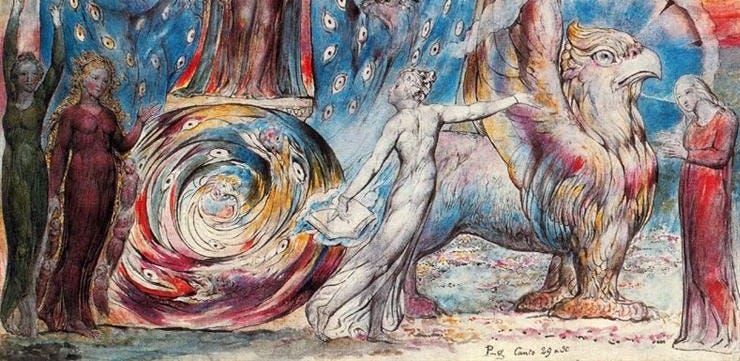
With the help of the poet and artist William Blake, who is responsible for all the images and poems below, this post introduces the practice of Threshold Visioning—learning, in moments of transition, to hover in motion so as to experience ideational portals into another realm. This is how Blake visioned worlds beyond our usual dualistic ‘two-fold’ ones, and it is at the heart of the last three L&P episodes from January. In this post, we’ll learn what Threshold Visioning is and how to develop it. At the end, there’s a list of actions you can take starting right now.
Unfolding Visions
Poet and mystic William Blake (1757—1827) talked of various ‘folds’ of vision, but by ‘vision’ he did not mean what comes in through the eyes. Merleau-Ponty has a good definition of this sort of vision, writing of it as ‘the means given me for being absent from myself’. This is where the world becomes exciting and meaningful —those moments when you are so alive that you get a break from the noise of self.
At the moment, we seem to have entered a different relationship with that noise; we are aswim in the complexity of optics. While these are exciting waters, Blake has long been directing us towards something else.
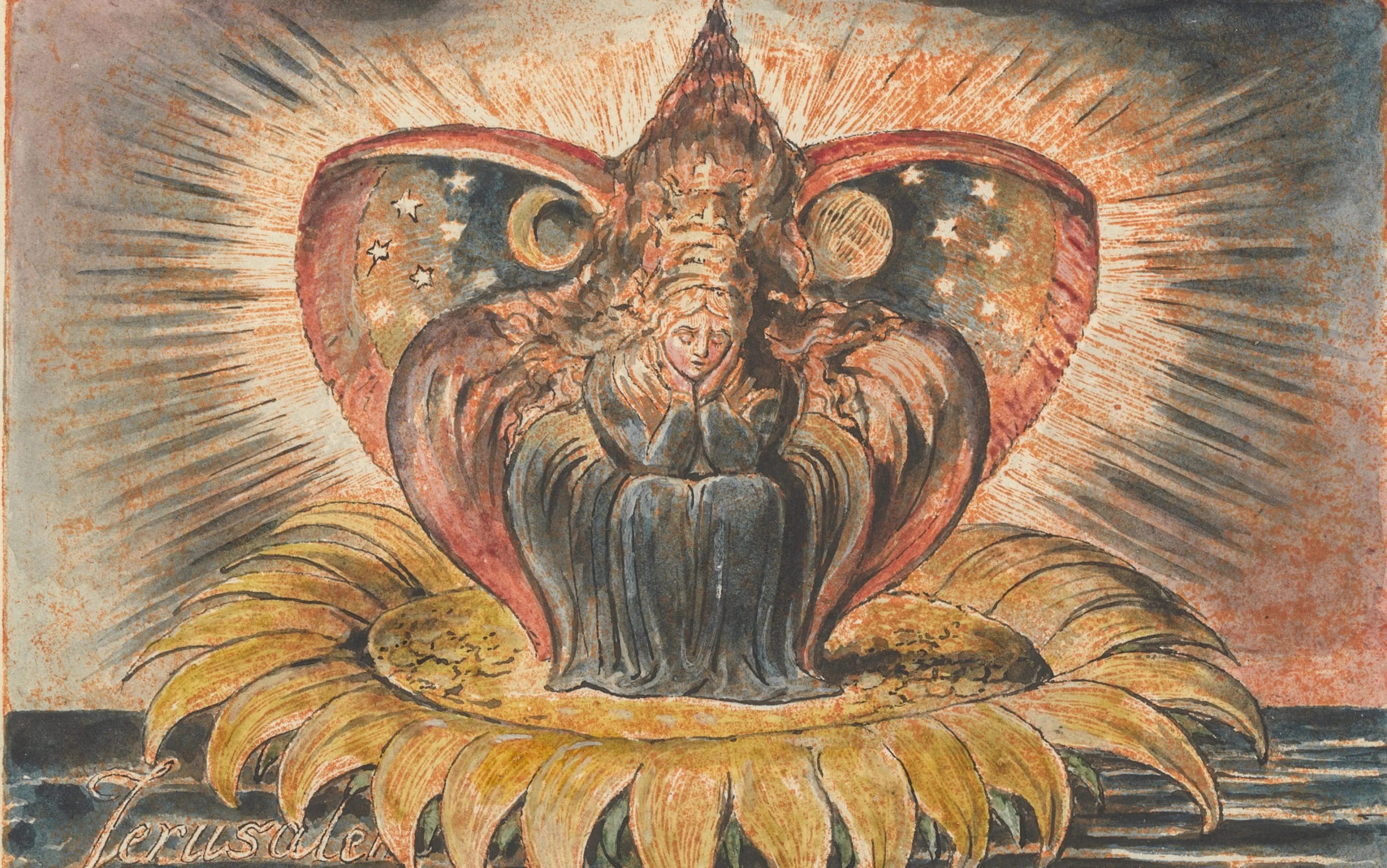
Off to the side of this stream, just a scramble up and over the mossy stones, there’s a waterfall tucked and waiting. Once you’re there, you’ll notice a ledge behind the rush; this is the threshold on which we can pause and presence into other potentials.
It is what Blake called “the place where Contrarieties are equally True.” Stepping behind the dualistic waters allows ‘three-fold vision’; self falls away and we can hover as pure life. From this position of presence, we notice new paths, what Blake calls the ‘supreme delight’ of the ‘four-fold vision,’ our life infused as wonder, meaning and complexity.
The chance to find and cross this threshold into new vision comes in this dynamic pause of self into presence. Think of it as the hummingbird hovering; it stays in one place, but it is always in motion. In this embodied, intersubjective, imaginative practice, you allow the air to hover you, trusting it to move your wings for you.
It’s a moment out of time. But as Blake is sure to point out, this three-fold vision that allows us glimpses of the fourth is not lasting or static. This ledge upon which we step is indeed a way out of day-to-day dualisms, but it is not a place to stay or hide from them—it is a place to let them be, and see them for what they are. It’s both temporary and lasting in its dynamism, a place in becoming where we see and sense differently.
At this threshold, we step out of our current ‘mental maps’ and reimagine the territory from another set of path-dependencies.
In that sense, Threshold Vision, a term that came from my ‘mishearing’ Blake’s ‘three-fold vision’, is the practice of embodying presence at the portal of any choice, and orienting into the complexity of love as one makes it.
It is a simple practice, but not an easy one. Can you imagine why this might be helpful?
Importantly, it is also not only one practice. There are many practices to this practice, many ways you can find into the feeling of it, many ledges behind many waterfalls, many ways into many thresholds.
You might find it while in conversation, for example, or while in meditation, or while singing or walking or swimming or doing yoga. You might get the glimpse while playing a sport, or while writing. (Maybe you have other ideas?)
Still, each time you get a glimpse of it, you receive the chance to practice. Feel into your body, into that space, and experiment—the portal will open, but you’ll have to walk through and open to seeing the world differently. See if you can be both moving and still at once, like the hummingbird, present and miraculous.
However you do it, being able to access what Blake calls the ‘three-fold vision’ beyond the two-fold of polarities means understanding the dangers and delights that come in holding paradox. It’s not quite as easy as riding a bike—perhaps its more like surfing; the waters can drown you just as surely as they can become the ride of your life. Let’s look into that. But first: the Complexity of Love? the Complexity of Optics? what did I mean by that above?
The Complexity of Optics
What I’m calling the ‘complexity of optics’ might be best understood as the water of the waterfall, it’s all that is flooding around you each day, that’s trying to get your attention. It’s the information and the noise, both inside and out. These chaotic optics can seem to be in an ongoing rush around you, causing your discomfort and also promising to offer you the solution to it. Most of the time you are swept up in it rather than surfing it. Hovering with your hummingbird wings is a way to change that position. It is rather delicate to have these little wings in such an onslaught, but in trying to use them, you’ll find they are in fact much stronger than the water. Indeed, even what is water might begin to shift.
But what are these optics? Take a minute and I am sure you’ll see them now all around you. The headlines of articles. The statements on social media trying to get you to like them or heart them or follow them. All that questioning or habitual thinking that feels as if it is running through your head. The many products your eyes fall upon each day asking you to buy them in promise that they will make things look better. And the way none of this ever quite lasts or lives up to itself, how the shiny wrapper ultimately ends up in the trash.
From fashion tricks to the titles of podcasts to the artwork of our YouTube thumbnails, many of us are caught up in creating optics that will draw others in. But how much do they actually have to do with what we really want to share or learn with one another? How much do they really reflect what is at the root of what we need to be given and what we so long to share?
This is the complexity of optics, and it is the habituation of much of the world right now. Because we imagine it must be so, the circle continues. Stepping into the threshold means taking a minute to hover out of all that, going to a place beyond how you look in the mirror or on the CV or in the App, and feeling the love again.
In today’s world, as long as you look the part, it seems as if you don’t have to actually play it. But this can be a hard way to live for those having to keep up this ruse for the rest of us; there is no distance between how you’ve become yourself and how you’re expected to continue. Polarities of ideas like ‘winning and losing’ or ‘us and them’ set up a pendulum that can only swing us between polarities. And this is lonely.
The complexity of optics is sticky and even addictive, that swoosh whereby we not only feel we have to judge a book by its cover but we also feel we cannot actually stop to read the book because we have a million other books to find first. No matter what ‘side’ you believe yourself to be on, in the complexity of optics, there is no place to rest. It is hard to take the dynamic pause, to find space for visioning. This is why we need the threshold, why we need to take a three-fold look at the world, why it is so helpful to find this safe place to go beyond the polarization and the either/or choices, a place we can rest, at least for a moment.
From our fashion to YouTube thumbnails, many of us are caught up in creating optics that will draw others in but that have little to do with what we really want to share with them.
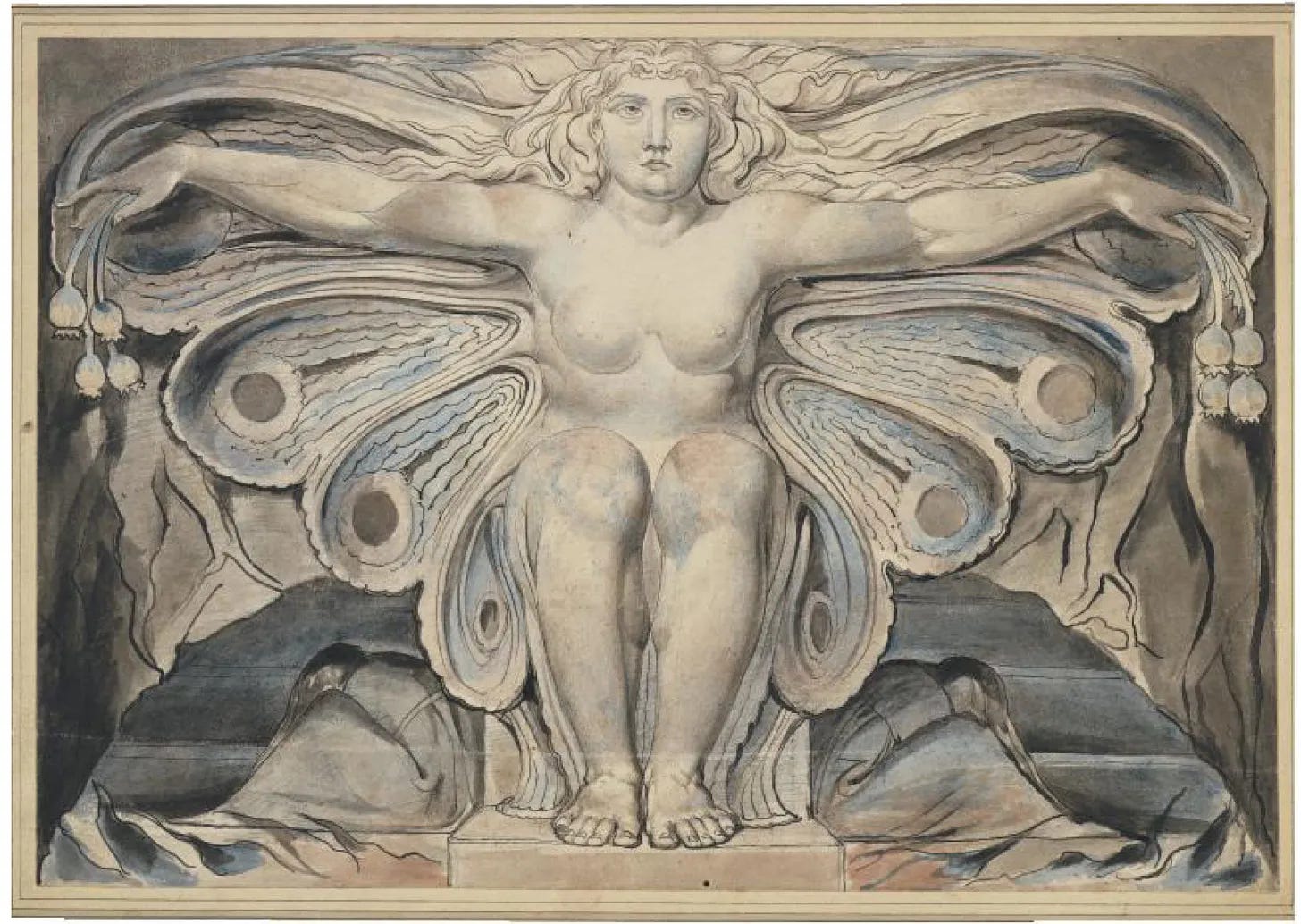
We are at an important crossroads now, one where we have the chance to reorient into the complexities of love rather than those of optics. To do so, we first need to recognize the complexity of optics for what it is, and then realize that there is a choice that exists, a space behind the waterfall where we can step, one that allows us to move behind the noise for a bit. We can hover like hummingbirds together here, giving name to what this motion fosters and orienting ourselves towards what connects us in healthy and meaningful habituations.
That is the orientation towards the complexity of love. To use such language at first might sound sentimental or even ‘weak’ if you have been flooded with the complexity of optics for too long. It can take some time to feel your way. Your senses might be overrun by that noise, and you may feel prone to assume ‘power’ means a show of force. But love really is where the power lives, and it is the most challenging and strongest and most meaningful practice that exists. It is ‘real power’ precisely because it does not need to prove itself with optics.
The Complexity of Love
But love is just a word, right? What is really behind ‘love’ as I am using it? What do I mean by ‘orienting towards love’ or moving towards the ‘complexity of love’.
First I should say that ‘complexity’ as its used here does not mean ‘complicated’.
In science and philosophy this word ‘complexity’ is used to open up webs and meshes of connections, to study multi-dimensional interactive systems, to point to the many dimensions and potential ways of reading any one experience. It’s a way of gesturing to all possible paths to the beach, even if we cannot count them, even if they are constantly changing, even if there is no one way to define ‘the path’.
Complexity is a way of saying that there is no way to ‘get a hold on’ all these potentials and possibilities from any one position of assessment, and so instead one looks for patterns that connect in ongoing dynamics. This is different from ‘complication’ which usually implies there are ways to get a hold on something, even if they are hard to figure out.
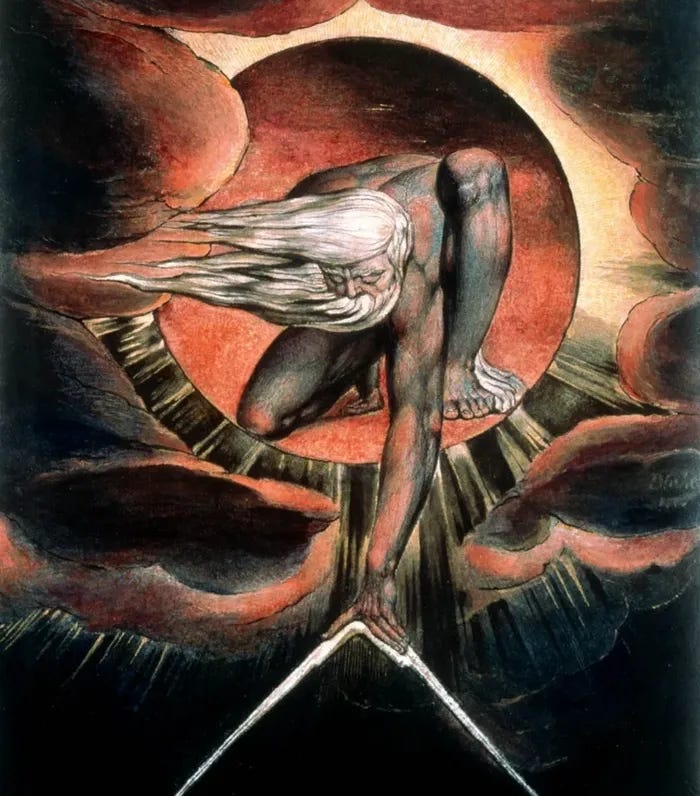
Complexity is a word that gestures into places we have not yet developed the abilities to sense, much less understand; it points into places still beyond understanding. This might look like an abyss or like chaos or like heaven. It might, to quote one of my favorite poems by William Butler Yeats, one of William Blake’s first champions, be as simple as that strange and miraculous bird now shrieking at us.
Does that sound too far out?
If so, to get a more everyday idea of complexity, think of the many layers of your favorite song, the many different instruments, rhythms, notes and harmonies. Think of how they align instantaneously with all the many systems of your senses. Think of the interweaving patterns tied up with every note, reaching out into each unique path of your experience from each unique experience of the person who wrote it. Think of all the other music they heard and the people they knew that influenced their life such they could write that song. Think of how this line goes on and on.
Or, for another example: Think of all the characters in your favorite novel and how they weave into the story that is its result. Think of the experience of reading it and how that traces from the experience of the author, into your own life. Think of a city and the many ongoing parts of its layers of activity, how those all get called ‘the city’ but tracing through each action would be infinite—like a million novels and musical scores playing out at once.
These are examples of complexity. But what about the complexity of love?
The Complexity of Love is an idea we can understand as the alignment, as the motion itself, as the movement, as all that dynamic bedrock at the heart of any of our creations, and any of our optics: It is the pull and push of ourselves as part of a process bigger than we can know, and it is our wanting to know it and be known by it.
Love is the means by which we can sense, even if we cannot yet understand, the dynamics of all our interrelation and co-creation. It is all that infuses what becomes the song, the city, the story. Love is the word we use to point to all that holds and moves us. Love is the action that has made us and that never stops making us. Love is always there, but feeling it as our infusing is what happens once we’ve relaxed our optics and heightened our presence. It is this sensing of all we encounter, once we’ve let ourselves be the dynamism without judging it, and without judging ourselves as if we are outside of it. It’s us letting the air hold our wings. Love is the experiential yes in all this ‘intersubjective’ lushness. It’s not being embarrassed to care. It’s the in-between action, the ongoing resonance, the thinking into its own patterning, the root of all grief.
Love is a verb.
It is the ongoing spirals of our couplings with embodiment, co-creating that embodiment and co-creating whatever is met as it. As you can probably sense, words rightly start to fall apart when we try and describe or define love because words are themselves way-makings of it.
It helps to think of it through a statement of action. This gives us a concrete example of what is always dynamic, always a verb. It helps to have phrase to help us notice the threshold and hover there in the motion of presence to experience Blake’s visioning.
So, in that spirit, I offer a phrase I learned as a child, one you might know as ‘the Golden Rule’. At first you might think it is too naive. It once seemed naive to me, too, and still does on days I’m infused with optics. But now I also know it is the key to meaning and flow, to the hovering and the surfing and the ride of our lives:
We are always interacting with our future selves, and interacting with the person we were in the past, and the way we treat the world as we encounter it is the way we will be in that future and that past. We live our best lives when we realize we only know a small fraction of ourselves, and we are meeting more of ourselves all the time. Our life is the life that is around us; its nested complexities of potential co-create our own.
In other words, do unto others as you would have them do undo you.
That’s the phrase as I learned it in Sunday School as a child, having no idea back then that it is an idea that is also found in many of our oldest religions and philosophies. It is in the Analects of Confucius (5th century), in Plato, in Aristotle, in Stoic philosophy, in Shintoism, in Zorastrianism, and many other places as well—it is a phrase as old as community.
Do unto others…It might sound too familiar, too sweet, but wait, this is the chance to duck behind the waterfall. If you feel the need to roll your eyes, go right ahead, then come back and let yourself take this seriously, because it is your fulcrum into a new world.
If it feels ‘too sweet’ at first, that is because our current complexity of optics has confused our understanding of power. At the end of the day, however, our greatest philosophers and spiritual teachers have come to back to this idea, and there is good reason for it.
Do Unto Others: the Complexity Imperative
Orienting towards love in practice of the Golden Rule was understood by the philosopher Immanuel Kant, often considered the most influential philosopher in modern history. Kant furthered and repackaged the Golden Rule in what he called the Categorial Imperative.
There’s a lot of debate in philosophy about what version of the Golden Rule is best, but Kant’s version, whereby he universlizes it, tends to be one of the more popular. In it, he brings out the ability we have to reason and to decide how we might act as if we were deciding how all other people would act towards all other people. Philosophically, once you get into the weeds of argumentation, this ‘all’ can be helpful because it allows us to consider the wider waves of regularities being set into motion by societal habits.
In other words, it becomes about how it feels to leave your front door each day.
It is about how safe or unsafe, how helpful or unhelpful, how nurturing or not, the world outside is for you, and you for it.
It becomes about whether you live in a world where people wait in line at the grocery store or whether you live in a world where everybody just steals what they can till it all runs out. It becomes about whether or not your city gets help if there is a hurricane, and whether your neighbor cares to give you a hand.
It’s not just thinking about ourselves, it’s also thinking about the general mood and atmosphere we live within. It’s something we often take for granted now, precisely because most of our atmospheres operate more or less on exactly this imperative, that of doing unto others. Is that changing now? It’s worth our attention.
Kant’s idea was that action could be universalized. In other words, the way we can ensure health in our larger societies and groups is to consider how we might want to observe others in the norm, in their everyday relations.
Would we, for example, really want to live in a place where everyone is stealing from one another, or where we have to watch out backs every time we leave the house? Would we like to live in a world where we all just treat one another as if life is not a precious experience?
Think of that in contrast to when you happen to witness some act of kindness on the street, or to that moment watching the sunset at the beach, or to the feeling of a good conversation, or the look in someone’s eyes when you help them. Or think of when someone helps you, takes care of you, offers a needed gift that you did not expect. The sensuality of those moments creates our atmosphere, one we might take for granted, but one that depends on how we treat one another in these times. In the complexity of this world, all those little interactions add up to a way of life.
This matters at every level, including the ways we talk to one another in social media, and the ways we talk about others there, and in what we accept in the ways those who are leading us treat us and everyone else. Few of us want to see people constantly being terrible to one another, and yet that is a habit that we could fall into if we continue in the complexity of optics mindset without remembering the complexity of love at its roots.
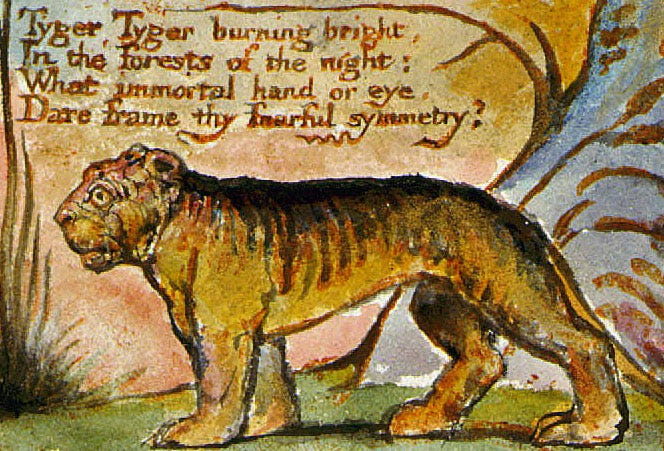
Complexity is a web of ripples that condition and co-condition the movements of our lives and the small actions, the ways we see one another treat one another, become big actions down the line.
In complexity science and chaos theory, most people know this as ‘the butterfly effect’ but it’s actually much more layered and nuanced and happening at all scales. We call it ‘complexity’ because we don’t yet know how to talk about it. What is clear, however is that the ways we make set up the ways we will be made; they widen or limit the parameters of what futures are possible.
The Categorical Imperative and the Golden Rule are expressions of saying that whatever we do, we are ultimately setting up what will be done, and that this is a matter of everyday, bodily feeling.
It the complexity of love, there are no sides.
In the complexity of optics, it is natural to take sides. In those moments when ‘our side’ seems to have the power of those optics, it might feel like we should use that against others—especially those who may have once used those optics against us—or that we should not care for the other side, or care if this hurts them. But living in that way leads into a numbing and ultimately grating, concretized existence, and it sets us up to be on the other side of it at some point. Those habits we go along with are those habits that are creating possibilities for us. It’s as simple as that, and also as hard to realize.
This is why hovering in the threshold can be so helpful. It gives us the practice of taking a moment to really look and know what we are doing, to orient from the complexity of love rather than the complexity of optics, even if we have to live in those optics much of the time. It also sets up a future that makes way for ‘supreme delight’; it opens us into other worlds.
Threshold Vision
Threshold Vision is the term I’m using here to express the practice of embodying our presence at the portal of any choice we might face and orienting into love before making it. This is also the practice of opening the way for new visions of the world.
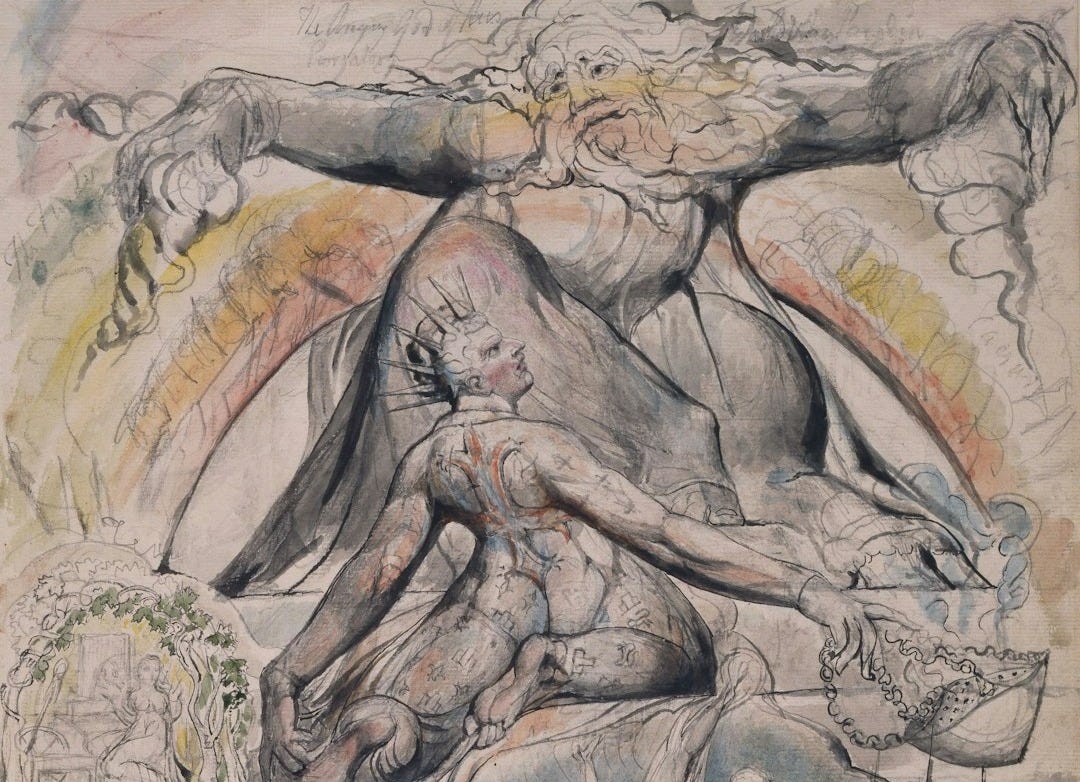
My first threshold visioning came as a mistake. It was late at night and we were already in bed. I was reading a biography of William Blake. The biography is by John Higgs and it is called William Blake vs. The World. Many of the ideas for this article came through my reading of this book, and I recommend it.
William Blake was a poet and artist, author, and visionary who lived at the edges of society. Since his death, his vision of love and other-worldly potential has inspired and oriented millions towards finding the motivation to continue. I loved his work as a teen and young adult and recently, I felt the need to revisit it. I wanted to remember that feeling Blake inspired in me throughout my younger years. So I went out and found this biography.
That night, just before going to sleep, I read the following passage about Blake’s idea of the state of Beulah, which is something like “a blissful, post-coital embrace from the whole universe”. I’ll quote Higgs in full below because it helps to explain what Blake means by the three-fold (and threshold) vision I’ve been mentioning above.
In the book, Higgs describes Blake’s ‘double vision’ and in so doing, we see Blake out for a walk in nature whereby he quickly gets into an argument with a thistle.
This is not quite the dualistic vision I’ve been presenting above because most of us do not go around arguing with thistles. But Blake lived in a world of visions, whereby even a thistle could become something to disagree with, the personification of the contrast. Still, the step out of that doubling (out of his argument with the thistle) and into the threshold as described in the passage below applies in the context of the above complexity. In this passage, the three-fold vision or threshold is understood as ‘Beulah’:
The paradise of Beulah is how many would imagine heaven, but Beulah as Blake understood it is just a temporary state. It is too passive to be a true heaven. For Blake, the idea that the afterlife consisted of angels sitting around on clouds playing the harp was not something he found remotely appealing or plausible. Instead, the heaven of Beulah is a temporary kindness that acts was a respite from the constant work of the universe. It was something we could enjoy for as long as it lasted, but it was a holiday from existence, not our ultimate goal…
By calling this state a ‘threefold vision’, Blake is saying that the world of Beulah is an addition to, no a replacement for, the twofold vision previously described. It was as if a state of grace descended upon him after exercising his imagination and experiencing twofold vision. It did not change the content of what he was experiencing, but instead altered what it felt like. There he was, in angry dispute with a thistle out int he gentle rolling fields of Sussex, when from nowhere a blissful spiritual balm found and embraced him.
That was the last passage I read that night, and somehow in my sleepy state, I registered it as ‘threshold vision’ instead of ‘three-fold vision’.
Now, it is hard for me not to think of this momentary respite or heaven as a threshold we rest upon in order to gather ourselves from the dualities of life. I see it as a place to gather presence and awareness, as a gift of reorientation, as a secret and safe ledge.
Threshold Vision is the space we have to consider the path before and ahead, and to consider what sort of atmosphere we want to live within, and how we want to orient. How might we live in love from the tip of the razor blade that is our everyday life?
With this orientation, a portal opens. In holding paradox, we move into the world of Blake’s ‘four-fold vision’, that beyond the threshold, beyond the three-fold. This is the place of mystics. It might also be comparable to the experience many have as psychedelic experience, but even that is only a taste of what is beyond this portal in our real, sober, shared life. Getting there starts with the doubling of vision, seeing the world’s ability to unfold as yourself, then moving into the threshold of the third, and beyond into the infinity of the folds.
What to others a trifle appears
Fills me full of smiles or tears
For double the vision my Eyes do see
And a double vision is always with me
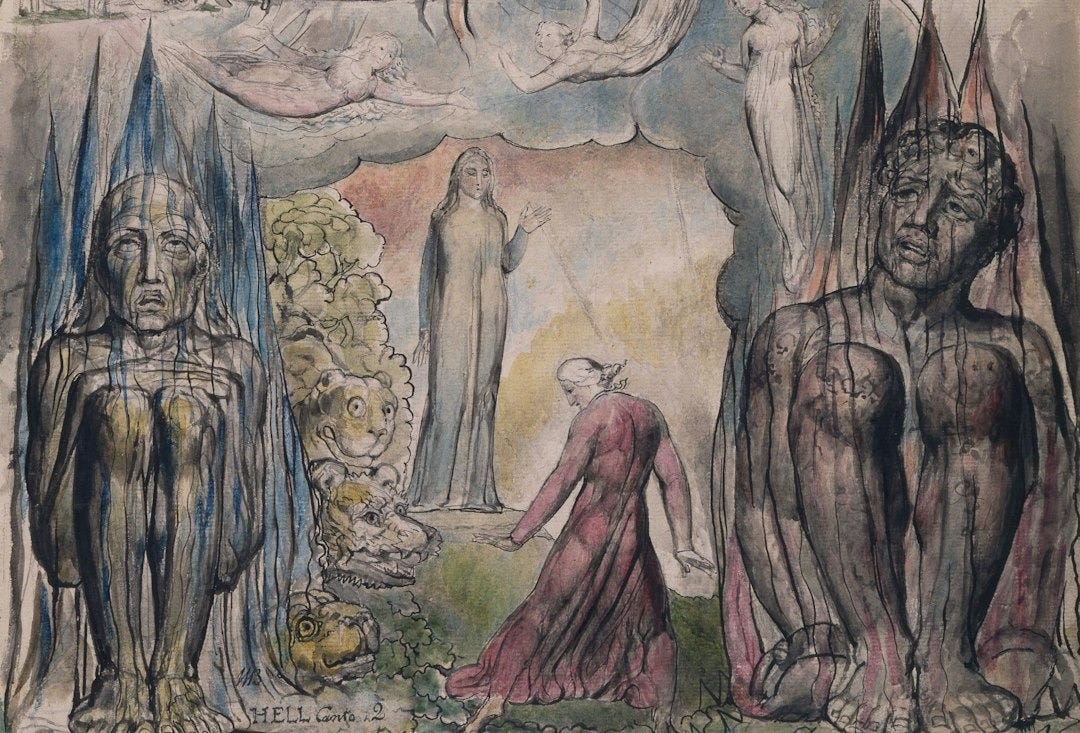
The journey to the threshold comes in cultivating our double vision. Polarities and contrasts are not bad. Paradox is the portal, the threshold from which we vision into further folds.
When we open our single world to another, we double it in asymmetrical contrast. That is not a place to stop but rather a pattern to feel. This has to do with the ways we set ourselves against ourselves, or against the world, so as to become more of ourselves, or so as to notice what more we are becoming.
All this is surely part of life at the moment, but there is something else, and this very doubling we are witnessing in such strong forms is itself the evidence that other folds exist for us if we can orient towards them now from the complexity of love.
Going from the dualistic fold into the three-fold is like stepping out of what we had till now considered natural, so as to see it with new eyes—coming back to where we started and knowing it for the first time. It is learning to recognize this endless coiling, this delight of movement, that is the practice. It is not about any number of folds or vision. It is about noticing that the folds change according to the feeling from which they are oriented.
For his entire life, starting in his childhood and going through to his last hour, William Blake talked about such visions. He walked in nature and one part of him saw tree branches blowing in the wind as others saw them. While another part of him saw them as part of his own body, living wild creatures that could never be tamed by words such as ‘tree’ but were animate patterns, fully in connection with him, fully part of him, fully beyond him, glowing as if by halo, touching into him, living and communicating directly with him as the becoming of his own life.
Through that portal he stepped. And in it, he found another existence. He was at peace with life and he became an inspiration for millions, though in his life and at his death, few knew of him and in the game of optics, it may have looked as though he had lost. In fact, not only did he ‘win’, he was beyond that entire game itself, in a place only those who pause upon the threshold can understand. Blake opened a path for us into complexities of love, and gave us ways of cultivating the strength to handle it:
Now I a fourfold vision see
And a fourfold vision is given to me
Tis fourfold in my supreme delight
And three fold in soft Beulahs night
And twofold Always. May God us keep
From Single vision & Newtons sleep
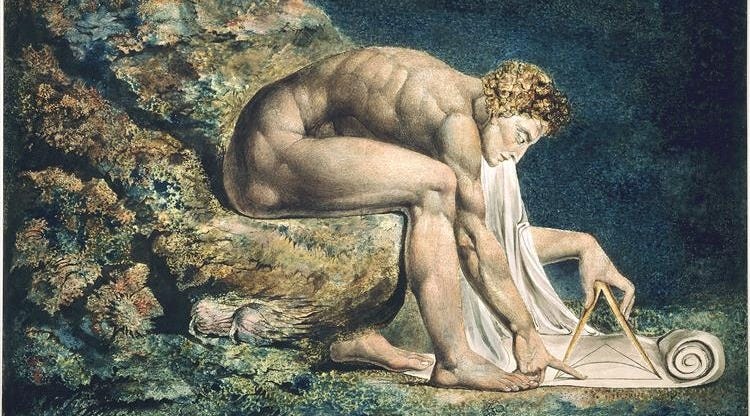
Here is a final quote from the Higgs biography, which explains this passage above and which I hope will help you, too, as you vision at the threshold:
“What Blake is trying to do here is to describe four different odes of perception, or states of awareness. The ‘twofold’ vision we have already encountered. This is a dual mix of physical reality and mental imagination, and again Blake stresses that he has this mode of perception ‘always’. The implication is that it is far superior to ‘single vision’ by which Blake means the material world objectively observed, without any contribution from the mind or the imagination. This is ‘Newton’s sleep’….
After threefold vision comes fourfold vision—a glimpse of the higher realm Blake refers to as Eternity. This, he tells us, is the ‘supreme delight’. It is also noetic, as William James explained, and profoundly ineffable. Here is the full blown mystical state that James analysed and studied. It is a much rarer state of mind than Blakes’s ‘twofold vision’ and not something he experienced every day…
Those who have had visions frequently claim that the experience was in some way more real than normal life. They often view the immaterial spiritual realm that they have encountered as a more fundamental state of reality than our everyday world of matter. This was very much Blake’s opinion and it was also the conclusion of countless mystical seekers going back centuries…
The adult mind is, in a sense, in a rut. Once it knows what is likely to happen in the world, it does not usually bother itself imagining scenarios that do not fall into this pattern…”
Threshold vision is the place where we get out of that rut.
Message Andrea Hiott
Four Ways to Develop Threshold Visioning
1. Do not just ‘go along with the inertia’; feel it & choose it.
Notice what is getting your attention, ask why it has gotten your attention, and notice how it makes you feel and what patterns it sets forth in you. Try considering this through the complexities of optics and the complexities of love and experiment with how you might orient your choice through them differently.
If you’ve gotten swept away in the complexity of optics, start naming it as it happens. If you’ve got caught in someone’s paradoxical glue, realize that as soon as you’ve noticed it, you’re on your way out of it.
Call it threshold vision or three-fold vision or whatever works for you, but practice connecting your path-dependencies with those who are also doing this in their ways. Find and support communities with orientations that are of the future you want to feel, and begin to use the word ‘powerful’ only for those sorts of energies, not for the ones that the rest of the world might be calling powerful right now.
Link in with those trying to hold paradox and live from the complexities of love. Don’t pretend like this makes any of us ‘always right’, or pretend as if we won’t still mess up. Instead of latching on to particulars and parts, look to the overall process and orientation. Be gentle with one another. Create the waters of a new ocean. Think of love as a line you are picking up and extending. Watch as the horizon opens forward in ways authentic and exciting.
2. Know that Holding Paradox is NOT the same as ‘being paradoxical’.
…though it does help you notice those patterns better and this is an essential skill for us to cultivate today.
Holding paradox is a phrase that points to the many ways we can learn to hold two seemingly contradictory notions in mind at once and still maintain the ability to function (to paraphrase Fitzgerald). This ability can be used in all sorts of ways. Learning how to do it no more implies that this knowledge will be used in healthy ways than learning how to be a good speaker means you will use that towards healthy messages. For a good example of this relative to current politics, please see this post.
Hovering in the threshold is not the same thing as being paradoxical on purpose; it is not the same thing as using ambiguity to confuse others into being unable to hold you accountable. There is a big difference and in cultivating three-fold vision, we get better at noticing it. Those who do not know how to do it, or who are not aware of it and its potential, will be more likely to fall into inertias moving them towards the opposite of what they think they are heading towards.
This is a skill and ability that is essential for the future precisely because being paradoxical (engaging in ‘double-speak,’ for example) can be used in any sort of way, unless people get used to recognizing it. The best way to do that is through learning how to hold paradox, learning how to develop threshold vision, stepping out of the doubling and looking at it from a third space.
Remember that orienting from the complexity of love means holding the paradox but not wielding it.
3. Think of the Small: In the end, it’s the only way to be Big.
Love is all that matters in the end. For Blake, this love is the ‘supreme delight’ and it is within the smallest of scales. Eternity is coiled into the small, for through the small one finds the infinite:
“To see a World in a Grain of Sand
And a Heaven in a Wild Flower,
Hold Infinity in the palm of your hand
And Eternity in an hour.”
And every Space smaller than a Globule of Man's blood opens
Into Eternity of which this vegetable Earth is but a shadow
One has to attend to the world and allow it to unfurl from its details. Taoist writings, which are a big inspiration for the way-making framework, discuss this portal into another world, too, as being hidden in the small:
The Tao can’t be perceived
Smaller than an electron,
it contains uncountable galaxies.
Notice the small moments of life, because that is where the love is felt. Love is not felt in optics.
Read books like The Death of Ivan Ilych about how a life was wasted with concerns of optics instead of concerns of love—and how we can, regardless how alone we are, find a way to hover in the threshold and feel into real power, even if it only comes at the end of our lives. But why not now instead? It is always the small acts that lead to those moments that cause big shifts.
Consider whether there is confusion about real power right now. Consider whether it is a confusion of the complexities of optics with the complexities of love. As John Steinbeck writes so well about in East of Eden, at the end of the day, the complexities of love are in the small acts, in taking time to do things with love. Life in the end is not a reality TV show or a contest but rather a matter of where we have connected beyond those optics, connected in all that is not in the public eye but rather that is in any small heart. As Steinbeck writes:
In uncertainty I am certain that underneath their topmost layers of frailty men want to be good and want to be loved. Indeed, most of their vices are attempted shortcuts to love. When a man comes to die, no matter what his talents and influence and genius, if he dies unloved his life must be a failure to him and his dying a cold horror. It seems to me that if you or I must choose between two courses of thought or action, we should remember our dying and try so to live that our death brings no pleasure to the world.
4. Live ideas as actions.
Higgs makes an important point in his biography of Blake when he writes that in all Blake’s talk of contrarieties, he is talking about “nothing more solid than ideas”. What he does not quite say, however, is that those ideas are only as solid as our actions, which is to say, the reality of life is dynamic movement. It is the acting from the idea.
All we are dealing with in our lives is a matter of the ways we have learned to think about life. Changing our thoughts changes our action.
As you vision at the threshold, remember that your thinking and feeling are the essence of your acting. The more you can be present with this feeling and orient it towards love, the more loving is your living.
Remember ideas are actions.
And action is continuous. Once you change the inertia, it continues along that path.
Know that you are a unique happening. We all live unique lives and those lives are unique actions in the larger world, and they really matter.