
Participatory Sense-Making
Moving together as ecologies of mind: "It is as if the other person’s intentions inhabited my body and mine his."

In this week’s late night Wednesday post on the philosophy and ecology of navigational mind, I’d like to share a few papers & further resources relative to ‘participatory sense-making’. We’ve had conversations with the authors of these papers, philosophers Hanne De Jaegher, Ezequiel Di Paolo, and Thomas Fuchs on Love and Philosophy but I’ve received emails and notes lately asking me if I’ve heard about “participatory knowing”, so I feel compelled to share this again. Please also read What is Participatory Sensemaking and Why Should We Care? by Beck Todd. Love, Andrea
I guess it would be interesting to let you know that these papers or work from these authors appear in the work of John Vervaeke and Iain McGilchrist who are two people listeners to L&P request or suggest often (McGilchrist and I met long ago, and Vervaeke will be on L&P w/ Darius Parvizi-Wayne this Autumn). Also, one of the preprints some have sent to me relative to ‘participatory’ builds in part upon the papers from Hanne, Ezequiel and Thomas, as you can see from these images from the Vervaeke paper’s bibliography below, which I also highly recommend of course:
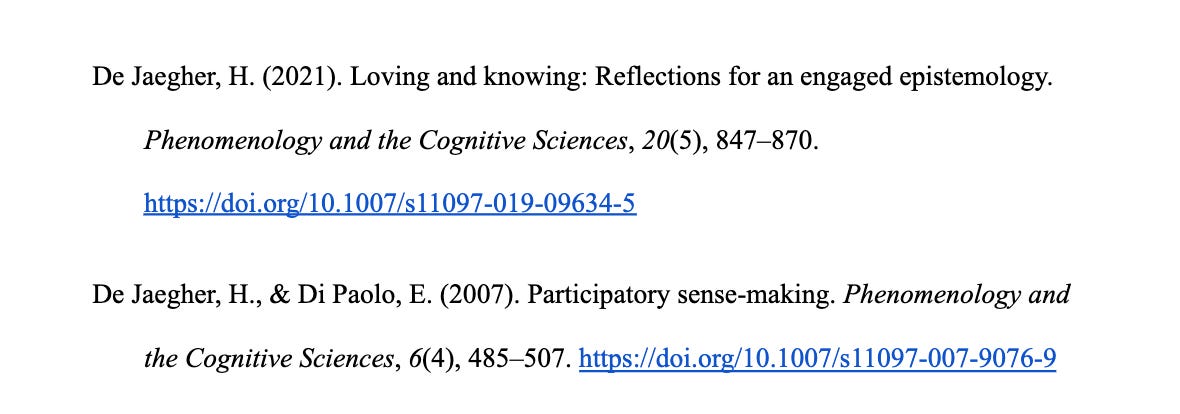
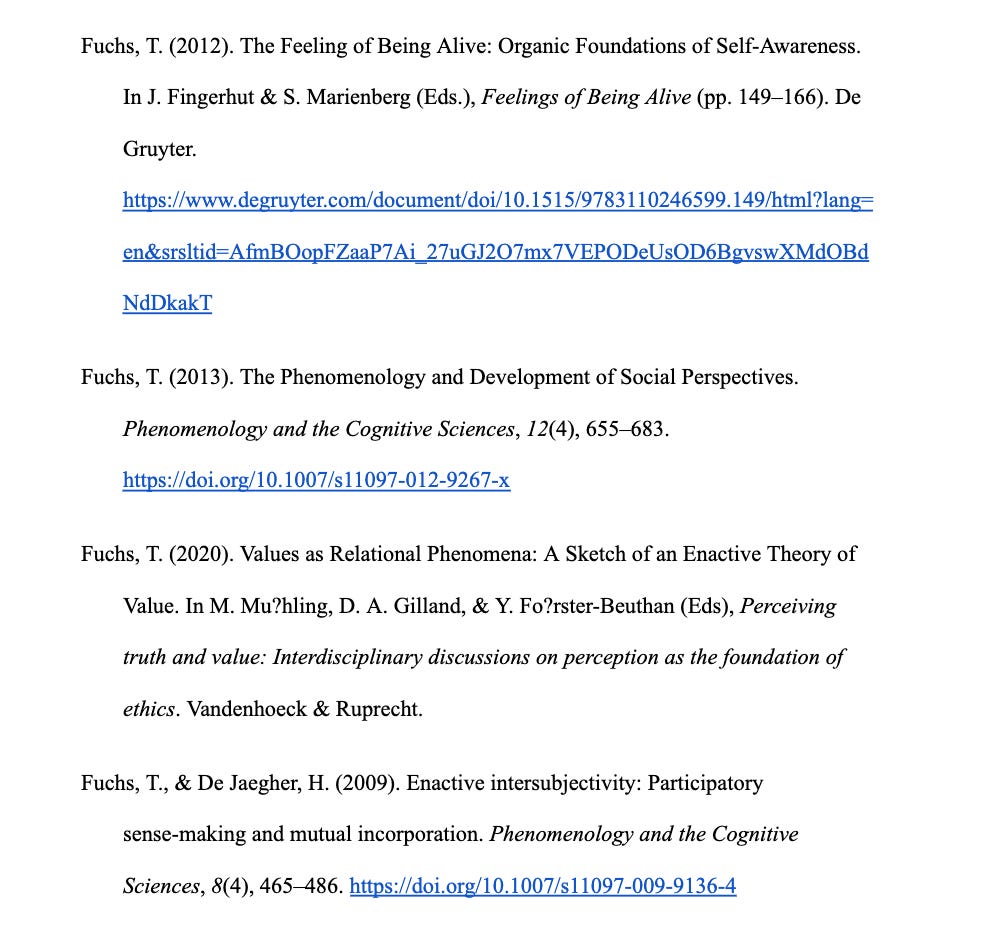
The two papers I want to draw your attention to here are Participatory Sense-Making: An Enactive Approach to Social Cognition from 2007 by Hanne De Jaegher and Ezequiel Di Paolo and Enactive Intersubjectivity: Participatory Sense-Making and Mutual Incorporation by Hanne de Jaegher and Thomas Fuchs from 2009.
These papers are the heart of “participatory” and the main idea is that we understand one another mostly by interacting with one another. We move together, we breathe together; we dance as shared space together, observing and interacting as minds that are not inside heads.
As Thomas and Hanne (and Merleau-Ponty) write, another body near ours “influences our own bodily movements and sensations, and vice versa. Thus, face-to-face contact elicits a process of empathic perception which Merleau-Ponty attributed to the prereflective sphere of ‘intercorporality’ and which he regarded as the basis of social understanding:
The communication or comprehension of gestures comes about through the reciprocity of my intentions and the gestures of others, of my gestures and the intentions discernible in the conduct of other people. It is as if the other person’s intentions inhabited my body and mine his (Merleau-Ponty 1962, p. 215).”
Sense-making
This is a word that goes back to another name I say often, Francisco Varela, one of the philosophers who connected the living, biological body and world with mind & started ideas that he and philosopher Evan Thompson would develop with Eleanor Rosch in The Embodied Mind (1991) and that Evan (who has also discussed this on L&P) would further develop in Mind & Life.
All this goes into what becomes extended by the authors above into the social world. At the core of it all is the recognition that to be a living being is to be active, and for the world to show up for it in ways that are significant to its continuance and thus are part of its ongoing exchange with its environment, its sense-making. Fuchs and De Jaegher link this to James Gibson and affordances (another common L&P theme), linking all we are encountering with bodily possibilities for action. To put that in more navigational terms, we move through spaces of regularity (be those geographical, conceptual, emotional, linguistic, etc.) by sensing what our movement makes possible and responding with what we are sensing. This is immediate and ongoing, but also layered and constellatory. How we move depends on what we sense and what we sense depends on what we are as movement.
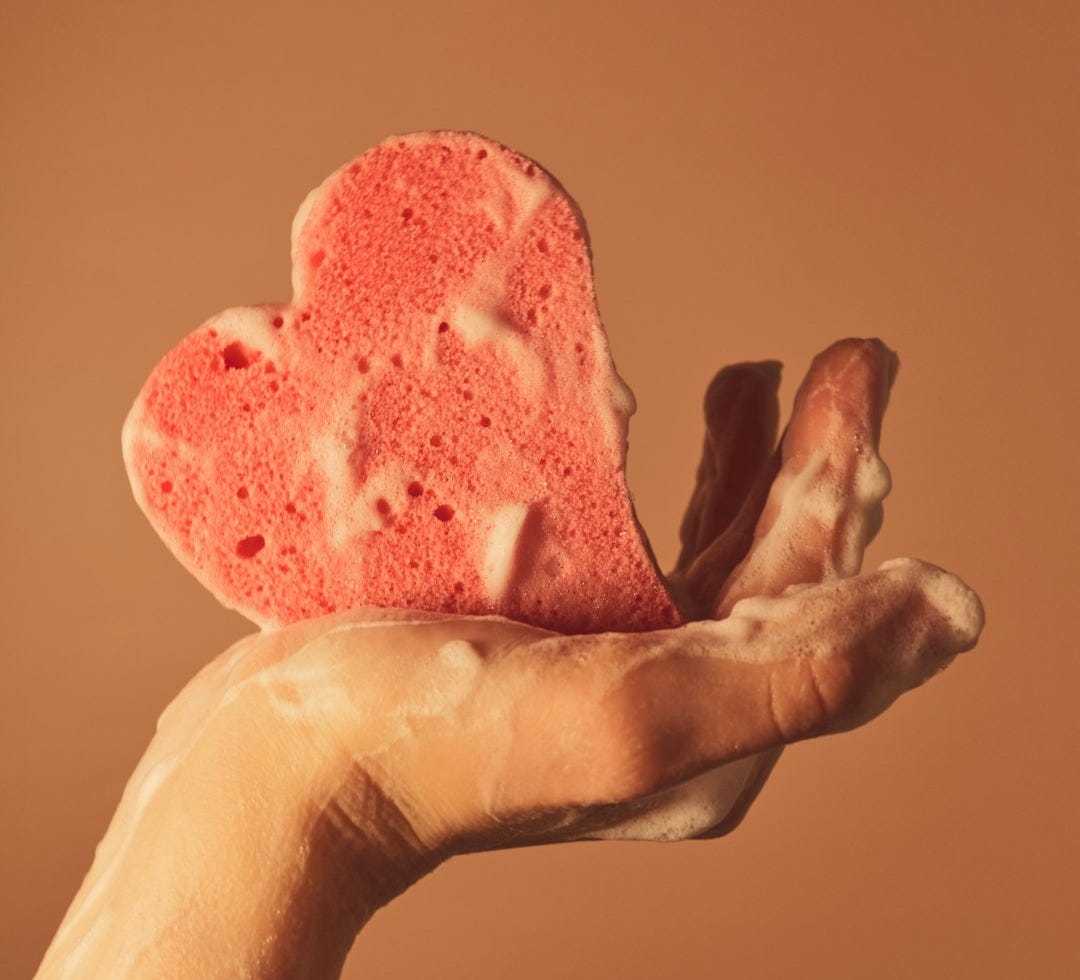
In another publication from 2008 by De Jaegher and Di Paolo called Making Sense in Participation, they offer a good example of this by way of the softness of a sponge. That softness is not a property sitting ‘inside’ the sponge but rather it is an answer to your pressing upon it; the softness and the pressing might seem like they are different but they are not.
In The Embodied Mind (1991), the authors lay out sense-making by showing that living bodies bring forth worlds as they encounter with it. To be alive at all is already to be making sense of the world, so bodies (without any need of language) are already engaging in cognitive acts, making their way through whatever is encountered. Much of this is inspired by phenomenology and Husserl’s idea of Sinngebung, whereby conscious bodies render worlds significant. I take this even further as the very mattering of living itself. And all of the above draws heavily on the ‘needful freedom’ of Hans Jonas and the autopoiesis of Humberto and Varela.
But the participatory papers take that needful freedom and continuity of life and mind and consider it at a further nested level, that of the social realm. Instead of taking the usual route and locating social understanding inside heads, these papers give a way to observe understanding as interactive. It is in the inteaction that understanding really lives (even, I would add, when that interaction is with yourself.) The coordination is the focus. When we interact, there is a bodily understanding beyond words. It is orienting the path.
Social interaction is a coupling (or constellating, as I would like to expand it) between bodies and it is this coupling or constellatory coordination that keeps them going. So long as each body is coherent, the constellation can also remain thus, but all are always in dynamic exchange, so this is quite a process!

Mutual Incorporation
We can also understand how this ongoing body-to-body coordination also nests with the movement of our own private phenomenology, of the ways we access our consciousness. As much as we might assume our cognition and thinking are only what we access of it, there is actually a whole lot of ‘our’ cognition that is also public and observable via faces, postures, gestures, actions and all the movement that we are as bodies interacting. Living bodies do not stop at the skin but extend as our movement and take in the movement of all we encounter. When those movements are oriented towards one another —we are orienting to one another, or when I am orienting with my dog or when your child is orienting with her grandmother — this is a ‘mutual incorporation’, a sort of becoming something expansive for a time. It can also happen with trees and oceans and sunsets, for mind is also ecological. And all of this is participatory. It is not separate or of some other realm from all the other words we might place on knowing and being and doing. These are all (always) all at once.
We are worlds of possibility.
♥️
good night
Papers:
Hanne De Jaegher and Ezequiel Di Paolo, Participatory Sense-Making: An Enactive Approach to Social Cognition, Phenomenology and the Cognitive Sciences, 2007.
Hanne De Jaegher and Ezequiel Di Paolo, Making Sense in Participation: An Enactive Approach to Social Cognition, in Enacting Intersubjectivity, 2008. (The companion to the 2007 paper; the source of the definition of social interaction, the spectrum of participation, and the corridor and fork examples used above.)
Thomas Fuchs and Hanne De Jaegher, Enactive Intersubjectivity: Participatory Sense-Making and Mutual Incorporation, Phenomenology and the Cognitive Sciences, 2009.
Walking is Thinking

Hi everyone. I went for a windy walk over two bridges through a small hail storm to try and clear my head and get my ideas in order to finish my every-other-Wednesday post, but it’s not going to happen.
the Navigational Approach to Mind

Mind is the navigational action of the body; it is first and always bodily.


There must be a German word for the arc of thought/affect that is sparked when reading something so erudite AND FAR-reaching and then feeling mixed, overwhelming sensations of recognition, love, mutual understanding, constellatory attuned synaptic firing that then collapses into wonder about how another’s mind can be so very aligned which then morphs into the yearn-y impulse to respond with so much gratitude and specificity about all that’s been sparked that brought you to the feeling of attunement … only to finally resolve into surrendering to paralysis because THERE. IS. JUST. TOO. MUCH. TO. SAY.
One of the most interesting pieces I've ever read on Substack, this is super aligned with my work and I didn't know a few of them. Thank you!