Thinking Like a Landscape
"We reached the old wolf in time to watch a fierce green fire dying in her eyes. I realized then, and have known ever since, that there was something new to me in those eyes..."

I find it extremely difficult to face up to the ways of the world sometimes.
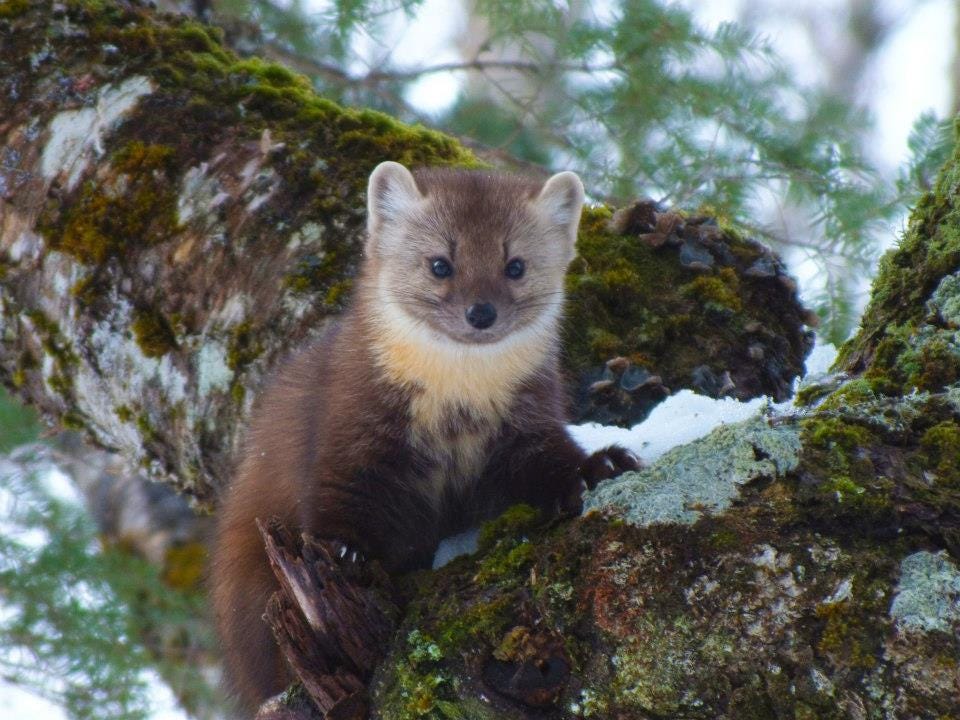
Recently, for example, I had to turn away when a pine marten came to steal the eggs of an osprey. All that work gone in the blink of an eye; the osprey had been tending them so carefully.
There was also a hawk that flew into a robins’ nest.
The nest had three baby robins in it. Their beaks opened wide when the hawk arrived. Why wouldn’t they trust it? Every other adult bird they knew brought food. But this time it was not their parents. The hawk took two babies into its claws and flew off with them. The third baby robin jumped out of the nest, perhaps to try and escape.
Both these situations above were recorded. But once, I saw something similar up close. I was leaving the hospital after a rather difficult experience. I was alone, and as I walked into the hot parking lot, I saw a hawk fly by with a bird in its mouth. It perched on a post right in front of me, so close I felt I should reach out to help. It was all very obvious, and over so quickly.
I have no idea what sort of bird the hawk had in its mouth, but I will never forget how it felt to see them there, at just that moment. It expressed exactly what I felt, the odd mix of life and death, violence and beauty. It was as if I were thinking as the landscape, or as if the landscape were me. It was as if I were both the hawk and the prey, the beak and what the beak was ripping. It was as if they were me, and we were demonstrating ourselves as something else.
The best I can describe it is seamless, silent. There were no distinctions between the birds and the hot southern sun and the pain I felt and the memory of how that pain had come into my life. And yet those were all irresolvable. Something had opened that I had not known till then. And whatever had opened had always been.
It is not so often I write or speak directly from this place, but I always feel it.
All the talk of ‘caring’ that comes on Love & Philosophy, all the effort I give towards shifting how we feel and think as that verb, is really about feeling ourselves as all this life around us, and not only the easy parts. It is about reaching into this same difficulty of facing up to the world as it is, and understanding that caring is all of it. It might seem like a paradox, but the only way to orient caring in ways less violent is to be able to see it for what it is: movements of caring are in tension and conflict.
Trying to discuss that directly and philosophically is a substantial part of why (especially in more academic contexts), I use ‘caring’ for the primordial urge of living itself. Caring for what? is a question that tells us a lot about the actions of the human, the robin, the hawk, the pine marten and the osprey. And about the tensions and conflicting systems of caring that we witness when we witness living.
Caring is the urge of the hawk and the robins at once. And this is a tension at the very urge of life. Only by facing it do we stop saying ‘nature is just like that’.
Humans are here to witness ourselves as this raw, wild urge we disguise as sentimental and weak. The power is there, waiting until we can handle it, until we can let our bodies feel into care as the primordial force.
The hawk is caring for its life and the robins are caring for their young. And by some strange turn of the kaleidoscope, we are both the hawk and the robin and the life that is watching them. To witness how systems of care entangle as pain and violence is extremely difficult, sometimes too difficult.
Helping one another, we can learn how to handle what it means to have choice and agency in this entangled mesh. It has to do with how we notice what we care about and care for and care towards, caring with all the life that is already the landscape thinking us, including and especially ours.
If we can hold this tension without trying to resolve it, we may feel a portal open.
To think like a landscape is to be the senses and soul of it, but also to let it be our senses and souls. We’ve hardly gotten started. To think like a landscape is to think like a body participating with itself beyond its bounds. Mind is more like a compass than a computer, but it is not trapped inside us.
"We reached the old wolf in time to watch a fierce green fire dying in her eyes. I realized then, and have known ever since, that there was something new to me in those eyes — something known only to her and to the mountain. I was young then, and full of trigger-itch; I thought that because fewer wolves meant more deer, that no wolves would mean hunters' paradise. But after seeing the green fire die, I sensed that neither the wolf nor the mountain agreed with such a view."
Aldo Leopold, Sand Country Almanac (from chapter Thinking like a Mountain)

Thanks for reading. I write unscripted and off-the-cuff every other Wednesday about some topic related the NAVIGATIONAL APPROACH TO MIND which I’ve been developing for a while now through my studies and research related to the hippocampus and the ecological and embodied cognitive sciences. I’ve also had a lot of conversations about this here. My next book discusses this more directly and you can find that here.
p.s.— Here is another, slightly sunnier walk I had recently: