
We all Care
from the textures of competition to the textures of care


“I was inspired by a person’s work, then they acted in some hurtful ways —should that change how I think of what they’ve created?”
I try to write here every other Wednesday, or as close as possible. These posts are general but motivated via the approach of way-making and navigability in philosophy and the cognitive sciences. This approach has to do with how we navigate abstract and emotional spaces with the same bodily sensualities and ‘machinery’ through which we navigate geographical ones—to live IS to make way. Realizing mind as movement as such means rethinking the metaphor of competition and noticing that we could better understand our primordial tension (the mark of the living) through care.
This is a ‘written-in-two-sittings’ post and I welcome revision and ideas about any of it. A poem is at the end, though this post may be too long for email and require clicking to read on the website. I hope you are all doing well out there! Thanks for being here.
After this was first posted, we decided to make a care index. Join us here: This a global directory of people who believe care should be central to how we build, teach, design, research, organise, and lead. Whatever your field, if care shapes your practice, this is a place to meet others who are trying to orient through care.

There are some pretty painful moments in academia. But some of the more painful I’ve witnessed come in watching the slow corrosion that comes through competition, and the way brilliance is wasted in the process.
In a roundabout way, this blog post asks: What would happen if we stopped trying to be stars and began to think of our work through constellations of caring?
Though there are many good communities that support one another in many universities all around the world, there are also some rather difficult forces that calibrate in systems that encourage people to think in metrics (publications, citations, positions, grant awards, etc.). This can promote habits of action that lead people to think of themselves as working against others in their field (or sky, just to push the metaphor). And so many end up wanting to be stars, without really understanding what that means.
This texture of competition could be reimagined as a different, less numbing, more meaningful tension, a tension to source a new sort of steering.
I write of that tension as care.
Way-making requires care as steam requires water. Caring gives all movement its direction. There is great tenderness in this. Care is the constitutive tension of living. There is no life that does not care or that does not need care to exist.
Care is not a feeling or a value but the primordial pull that has to be there for anything to come into living existence. It’s the friction, the blurring of bounds, the tension of transitions in continuance.
Caring is the constitutive tension of being alive, of being oriented and orienting; it is the action in form; all ethical or axiological claims only make sense through this.
When we try and understand all this ongoingness, all this way-making, we do so through communicative representations like words and maps and images. These are ways we trace navigations through various spaces (once measured, those are ‘landscapes’).
Navigation is always motivated, oriented, because to talk of navigation is to discuss some assessment from some time and space. We don’t find our way unless we are caring for and towards—asking ‘caring for what?’ or ‘caring towards what'? tells us a lot about that position and its connection to other nested systems of care. If we look at the choices of our political leaders, for example, we can see the arc of what they care about without having to rely on whatever words those same leaders might say. The actions are the arc of caring.
Care is what makes movement into a path. It is what opens paths for us and others.

And yet, care is not a word we discuss much as being the root and energy of why we do what we do in academic environments.
Competition has been something of the norm there, accepted as if it were somehow the only way to orient. In a sense, we have been caring for it.
But today, as many of the old structures and scaffolds of academia now seem to be collapsing (papers can be written by AI and the whole system of merit now looks strained outside of practice; universities have become more like companies and are also now under attack in that system) it might be a good time to reconsider what we have been assuming as our scholarly glue and fuel. We might remember those philosophers and scientists of the past who were closer to the nerve of caring, and we might again reprioritize the urge. What do I mean by urge? That which compels us. That which converses with us via and as the world around us; the cognitive feeling-action urging us to find and make way.
What if we stopped cutting our lives from fabrics of competition?
What if we began to vibrate into textures that notice the care?
Some of you might want to roll your eyes now but care is powerful. Care is the first and the last of everything. It is what we are in this life. To turn all that power and energy into competition (even as just a metaphor) wastes a lot of what birth gives us from the start, which is this caring necessity.
Care is what we are when we arrive and what we need in order to survive and what is often generously provided to many of us to help us ease out of this form again.
Who is going to make the next computational model from that stance? Or write the next science fiction book?
To go even further and bring this back to the nested landscapes of academic life, what would it look like if we built education through the lens of caring? And what would it mean for us to consider our colleagues as orienting through care?
Well, we would still have plenty of tension, but we would also likely be able to hold that tension better and help one another alchemize it towards paths of health.
It might also help us better notice what and where exist the paths of responsibility. Actions are always part of systems of caring. So again, asking: Caring for what? will tell us a lot about how to think through law and ethics. The tricky thing is of course how to define care, which is why it can be helpful to consider this through the lens of navigation.
Caring is the primordial urging that is life, but to really communicate about it and represent it, we have to determine a position and a landscape and then we can map the paths of that urge as trajectories of time and space.
Care is the literal constitutive actions and those actions can never be absolutely represented, but can be communicated about with much more precision than we deal in currently.
So let’s turn back to the subject of fame and take a bit of a broader lens on it, though I started with considering it through the lens of the academic scholar.
Fame is a subject I grapple with at many levels because I was around it when I was quite young (a story for another time). After that, for most of my twenties and thirties, I tried to disappear from the public eye as much as possible. I basically stayed off social media for its heyday. I had specific and difficult reasons for moving away from the world of ‘being seen’, as my run-in with fame was rather terrifying and disorienting. I had to find my way out of it and how did I do that? Through embracing the precarity of care. Caring for myself and my body and animals and plants and even caring for those whose actions were dangerous to my life, though also caring enough to be sure I did not engage with them. In this time, I realized:
Care is literally what keeps us alive.
There were moments when people cared for me that made all the difference. Sometimes those people were authors long dead or the lady at the supermarket. Their caring and the miracle of how and when it appeared, saved me and showed me how caring begins with the ways we treat our bodies and the ways we consume and use language and images.
I wonder if there is any way we could help one another feel more of this texture and tension that IS love and care in the world of academia, and I wonder how we might live into that motivation and alchemize those tensions we have been assuming as ‘competition at base’ and consider them as ‘rooted in caring’—maybe that would even become so.

We could reimagine the texture of what we are taking for granted, recalibrate from an understanding of ‘systems in competition’ to systems in tension, caring in different directions and dimensions. We might then look at these in landscapes and imagine and model them as paths, and see how they explore the world differently and how they might connect.
We might better notice the texture of all these sensual material conversations. What does the texture holding our actions and orientation feel like in this moment, in this conversation, in this train of thought? How is that able to be felt (literally) in our bodies? What happens if we shift this through considering it via what the parts of this friction are caring for?
This is something we can do wherever we are in academia, and it might even be a way to begin to discuss education differently. The first step is to notice when we are assuming the texture of competition and see if we can remodel that to understand it as systems of caring that have come into tension.
When we try this shift, we start to realize that the person acting badly towards us is doing that towards something that person cares about. What is it? What is it from their path and trajectory? How does it look from the paths they have taken in life?


In moments of tension, we can ask (hopefully together): What do we care about? What sorts of paths of care are tangled here? How can these tensions be understood as tensions between caring actions? And caring actions for what?
So the answer to that opening question is YES. We can better understand the work someone does through this lens of caring. We can take the work as one path in a landscape, not as the whole person. And we can (at the same time) ask what they are caring for when they engage in other actions. We can trace that caring responsibly, because character matters just as much as creativity; we are helping one another orient our future potentials through what we support.
Some resources about academia and the toll on our health
Nature editorial: “The mental health of PhD researchers demands urgent attention” (2019)
RAND Europe: Understanding Mental Health in the Research Environment (2017)
Evans et al., Nature Biotechnology 36, 282–284 (2018)
Bergvall et al., Journal of Health Economics (2024) — the Swedish prescription data study
Guthrie et al., RAND Health Quarterly 7(3) (2018)
PLOS ONE: “The impact of working in academia on researchers’ mental health” (2022)
Peer-Reviewed Studies
Evans et al. (2018, Nature Biotechnology), summary and links here
2024 Swedish longitudinal study at ScienceDirect
2022 systematic review in PLOS ONE at PubMed Central
On the Competitive Structure Specifically
A narrative review in PMC at PubMed Central
Nature‘s editorial commentary here is interesting too in this: Nature
One PhD student in the Nature survey commented: “The academic system needs a drastic overhaul. It has become a corrupt and abusive system.” Inside Higher Ed
Further notes: In this article I speak from inspiration from works of Maxine Sheets-Johnstone and many others. Lately I have been reading Linguistic Bodies by Ezequiel Di Paolo, Hanne De Jaegher, and Elena Cuffari, Phenomenology of Perception by Maurice Merleau-Ponty, and also The Visible and the Invisible. Also the work of Hans Jonas, especially The Phenomenon of Life, and Evan Thompson’s Mind in Life. I also want to aknwledge a conversation with Anthony Bucci that helped me notice some of the more important ideas related to some of this above. And more. I’ve also been reading this wonderful paper by Marek McGann
McGann, M. Facing life: the messy bodies of enactive cognitive science. Phenom Cogn Sci (2024). https://doi.org/10.1007/s11097-024-09958-x
and this one from Nonaka which Marek recommended.
Nonaka T (2020) Locating the Inexhaustible: Material, Medium, and Ambient Information. Front. Psychol. 11:447. doi: 10.3389/fpsyg.2020.00447
And here is a recent talk I did about some of this for the highly recommended ENSO Seminar Series
Additionally, I would like to share that I was part of the following new book collaboration AI Everywhere, where I wrote about Love and LLMs and how technology could help us care better:
One more thing: do you know Rahul’s podcast? It’s so good and it was fun to have a conversation for it with him. If you like philosophy and theory, you will like his work:
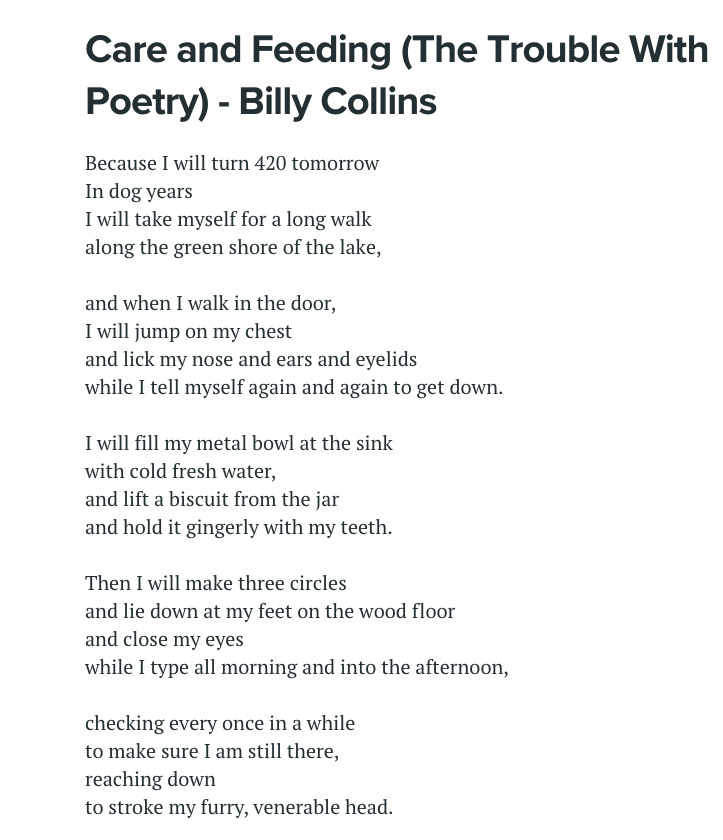
And here is a wonderful poem of care from Billy Collins:
❤️
 | A guest post by
|